
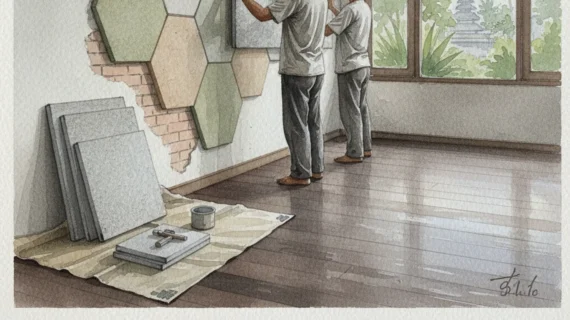
Why Acoustic Work in Bali Hotels and Resorts Requires a Different Approach
Hospitality properties in Bali typically combine open-plan design with a humid coastal climate. That combination creates two distinct problems: external noise such as beach club bass and ocean sound, and the risk of acoustic materials degrading in high humidity. An experienced acoustic contractor addresses both by applying a layered mass-isolation system to guest room walls for noise control, while specifying hydrophilic or waterproof materials for interior panels to protect acoustics without compromising the property’s aesthetic.
Both traditional and contemporary Balinese architecture favour openness: wide apertures, semi-outdoor corridors, and gardens that flow directly into the main building. That design language is part of the appeal, but from an acoustic standpoint every gap and open surface is a potential noise path that needs to be mapped before construction begins.
International guests staying at a premium Bali villa or resort arrive with a clear expectation of quiet. Acoustic privacy, the condition in which conversation or activity inside a room is not audible next door or in a public area, is a baseline standard for four-star properties and above. Failing to meet it does not just generate a negative review. It affects the decision to return.
An additional challenge comes from how many Bali resorts sit close to entertainment zones and the beach. Low-frequency energy from beach club speaker systems, diesel generator units, and late-night surf each call for a different technical response than conventional urban noise. All of these variables must be analysed during the survey phase, not addressed reactively after construction is complete.
The Difference Between Noise Control and Acoustic Treatment in a Hospitality Property
Noise control prevents sound from transmitting through boundaries: the room next door, the plant room, or a public area bleeding into a guest room. Acoustic treatment manages reverberation and speech clarity inside a space, in a ballroom, resort restaurant, or conference room. Achieving full comfort in a hotel or resort requires both disciplines, designed together by a specialist team.
In practice, misunderstanding this distinction leads to misdirected spending. A property manager who invests heavily in decorative acoustic panels inside guest rooms, without first reinforcing the partition walls, will find that noise from the adjacent room remains clearly audible even though the room itself feels acoustically “dead.”
For a full technical explanation of how the two approaches differ, see our separate documentation on the difference between noise control and acoustic treatment.
In a hospitality property, both approaches are usually needed, but in different zones:
- Noise control is the priority for inter-room partition walls, floor-to-floor assemblies, facade walls facing external noise sources, and mechanical plant rooms.
- Acoustic treatment is the priority in ballrooms, conference rooms, restaurants, lobbies, and spa areas, where speech comfort and audio clarity matter most. The same principles apply to auditorium and hall soundproofing in large-capacity venues.
A well-designed project integrates both into a single acoustic plan rather than treating them as separate scopes.
Moisture-Resistant Acoustic Materials for Tropical Construction in Bali
Relative humidity in Bali, especially in coastal and valley areas, can exceed 80 percent throughout the wet season. That conditions rules out material specifications that work fine in Jakarta or in buildings with fully sealed HVAC systems.
The table below lists the primary materials used in TG Acoustic hotel and resort projects in Bali, along with the technical reason each is selected.
| Material | Primary Function | Advantage in Tropical Climate |
|---|---|---|
| Rockwool, density 60-100 kg/m3 | Sound absorption and isolation inside wall cavities | Mould-resistant, stable across temperature and humidity fluctuation |
| Reinforced MLV (Mass Loaded Vinyl) | Blocking low-frequency sound transmission | Flexible, does not absorb water, durable in layered construction |
| Moisture-resistant gypsum board | Final finish layer and air barrier | Special formulation prevents swelling and mould growth |
| Vapor barrier foil | Insulation wrap to prevent condensation | Keeps rockwool dry and maintains stable acoustic performance |
| Hydrophobic-coated acoustic panels | Surface sound absorption in interior spaces | Water-repellent coating preserves absorption performance over time |
Correct installation matters as much as material selection. High-quality rockwool loses its effectiveness when fitted inside a wall cavity that is not properly sealed, because moisture vapour accumulates in the cavity and causes condensation. For this reason, every layer in an acoustic assembly on a Bali property must be designed with vapour migration in mind, not just its sound-reduction value.
How TG Acoustic Manages an Acoustic Project at a Bali Property
TG Acoustic follows a four-stage workflow on every hotel and resort project. Each technical decision is based on measured data, not assumption.
- On-Site Survey and Audio Diagnostics
A technical team visits the property to measure existing noise levels using a sound level meter and frequency analyser. Measurements are taken at multiple points: inside guest rooms, in corridors, near noise sources, and at the external facade. These readings establish a baseline that sets realistic decibel-reduction targets. - Design and Budget Planning
Using the survey data, the team produces acoustic construction specifications for each zone, calculates material quantities, and prepares a detailed cost plan. The design accounts for existing architectural constraints, including the wall thickness that can be added, the ceiling height available, and existing MEP routing. - Acoustic Construction
Installation is carried out by specialists trained in acoustic construction techniques, not general labour. Details such as structural decoupling, acoustic gap sealing, and the correct sequence of layer installation have a direct impact on the final result. TG Acoustic uses a phased, zone-by-zone work schedule to avoid significant disruption to hotel operations. - Decibel Testing and Handover
After construction, the team retests at the same measurement points used during the initial survey. Results are documented and compared against the targets set at the design stage. Handover takes place only after test results confirm that the agreed specifications have been met.
The testing methodology references international standards, including ISO 10140 for the measurement of sound insulation in building elements, so the figures reported can be independently verified.
Cost Factors for a Bali Hotel or Resort Acoustic Project in 2026
Project costs for hospitality acoustic work in Bali vary considerably and cannot be quoted as a single figure without a site survey. However, understanding the main cost drivers will help a hotel operator build a more realistic initial budget.
- Total area and scope. Treating a single room type replicated across dozens of units has a different cost structure than treating a single large space such as a ballroom or spa.
- Target STC rating. Reaching STC 45 requires a simpler assembly than STC 55. Each additional 5-point increase in STC generally calls for more mass or more complex decoupling techniques.
- Existing structural condition. Thick brick walls are easier to upgrade than lightweight partitions or half-open construction. Properties with many semi-outdoor areas require a more material-intensive approach.
- Material logistics to Bali. Some specialist materials, including reinforced MLV and laminated acoustic glass, must be shipped from outside Bali. Freight cost and lead time should be included in the budget from the outset.
- Work scheduling. Projects carried out outside operating hours or in a phased zone-by-zone sequence to protect the guest experience carry a different cost structure than work on a vacant building.
For more detail on cost structure and indicative per-square-metre ranges by construction specification, see our page on soundproofing installation pricing.
FAQ: Common Questions About Acoustic Work in Bali Hotels and Resorts
- What STC rating should partition walls between rooms meet in a 4- or 5-star hotel?
- For 4- and 5-star classification, the target is STC 50 to STC 55. At that range, normal conversation and a television at moderate volume will not be audible in the adjacent room.
- Can soundproofing work at a Bali resort be carried out without disturbing current guests?
- Yes. TG Acoustic uses a phased, zone-by-zone work method, restricts noisy construction to set hours, and contains dust and vibration so the rest of the property continues to operate without disruption.
- How is low-frequency noise from a nearby beach club handled?
- Low-frequency bass from outside requires heavy-mass blocking on facade walls, laminated acoustic glass of the correct specified thickness, and an airtight door sealing system.
- Is rockwool safe to use in Bali’s tropical humidity?
- Yes, when installed inside a properly sealed assembly. TG Acoustic uses high-density rockwool (60-100 kg/m3) wrapped in vapor barrier foil and finished with moisture-resistant gypsum board so the material stays dry.
- Does TG Acoustic carry out on-site surveys at project locations in Bali?
- Yes. Bali is one of TG Acoustic’s primary service areas. A technical team can be scheduled for a site visit, existing noise measurement, and structural analysis anywhere across Bali.
Conclusion
Acoustic work in a Bali hotel or resort is not simply a matter of fitting sound-absorbing panels. It is an engineering discipline that requires a thorough understanding of tropical architecture, the specific noise sources on the site, and the comfort standards that international guests already take for granted. Errors made during the planning stage, whether the wrong approach or the wrong materials, are difficult and expensive to correct after construction is finished.
TG Acoustic ensures that every technical decision in your project is grounded in measured data, not estimates. From the initial survey through to the final handover test, the process is structured so that the outcome can be verified and matches the specifications agreed at the start.
Discuss your Bali hotel or resort acoustic project with the TG Acoustic specialist team through our consultation form. The technical team is ready to assist from survey through to handover.