
Table of Contents
Why Luxury Villas in Bali Need a Dedicated Soundproofing System
Luxury villas in Bali face noise from multiple directions: beach clubs, road traffic, and commercial activity that runs well into the night. Tropical architecture with high ceilings and open walls reflects sound rather than absorbing it. A properly engineered soundproofing system keeps rooms private from one another and keeps environmental noise from reaching guests.
The corridors of Seminyak, Canggu, Petitenget, and Uluwatu now place premium villa properties directly alongside active beach clubs, busy restaurants, and tourist traffic that moves almost around the clock. The wall of a guest bedroom can sit less than twenty metres from a commercial noise source, while the guest’s expectation is the exact opposite: complete quiet, privacy, and audio comfort that feels remote from any city.
Beyond external noise, many premium villas run mechanical equipment that generates noise from within: pool circulation pumps, chiller units, standby generators, and centralised HVAC systems. These mechanical sounds travel through concrete floors and walls, re-emerging inside bedrooms as a low hum that is difficult to trace to any single source.
Bali’s tropical architecture adds its own acoustic challenges. High ceilings, large garden-facing openings, and hard floor materials such as terrazzo or marble allow sound to reflect repeatedly before it fades. Inter-room privacy in multi-suite villas is frequently inadequate because partition walls are thin and were never designed with acoustics in mind.
All of these factors make acoustic planning a core quality standard for a premium property, not an optional upgrade.
How Soundproofing and Acoustics Work in a Tropical Villa
There are two distinct technical approaches to managing sound in a villa, and they are not interchangeable. Understanding the difference between noise control and acoustic treatment is the right starting point before specifying any work.
Noise control stops sound from moving between spaces, or from the outside environment into the building. The principles are mass, decoupling, and sealing. Heavier, multi-layer walls, frames isolated from the main structure, and every gap around door frames, pipes, and cables closed tightly with acoustic sealant work together to reduce sound transmission significantly.
Acoustic treatment works inside a room. Its purpose is not to stop sound from escaping but to control how sound behaves within that space. Absorber panels reduce the energy and decay time of sound, while diffusers scatter sound waves so they do not concentrate at a single point. A villa home theater or karaoke room needs both: noise control so sound does not leak out, and acoustic treatment so the audio quality inside sounds clean rather than muddy.
In a villa that is already built, both approaches can be applied without demolishing the main structure. Additional insulation partitions are fitted inside existing walls, ceilings are re-hung using decoupling systems, and absorbers are positioned based on room dimensions and the dominant problem frequencies.
There is no single solution that resolves every acoustic problem in a villa. Each room has its own structural conditions, noise sources, and comfort targets, so specifications must be designed room by room after field measurements are taken.
Moisture-Resistant Acoustic Materials for Bali’s Coastal Tropical Climate
Humidity on Bali’s coast can exceed 85 percent during the wet season. That is not a minor inconvenience; it is a genuine threat to any building material not designed for that environment. Acoustic materials chosen without regard for humidity will absorb moisture, lose insulation performance, and eventually become a substrate for mold that damages the villa’s interior.
Material selection for an acoustic project in Bali requires one additional layer of protection compared with equivalent projects in drier urban climates.
- High-density Rockwool: This mineral fibre material is naturally hydrophobic, meaning its fibres repel water and do not retain significant moisture. Rockwool at a density of 60 to 100 kg/m³ delivers sound insulation performance alongside the thermal resistance needed in a tropical climate.
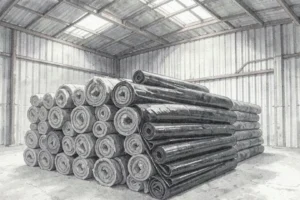
- Mass Loaded Vinyl (MLV): This thin, high-density membrane is installed as an additional layer behind wall or ceiling finishes. MLV is effective at blocking low-frequency sound transmission that often passes through porous materials, and its non-porous nature makes it resistant to mold.
- Moisture-resistant board: As the final layer, cement-based or specially coated gypsum board tested for high-humidity environments is used. Every joint and material boundary is sealed with acoustic sealant that remains flexible after curing.
Applying the right layers in the correct sequence matters as much as material selection itself. The best materials installed with a gap in the seal will not deliver the expected performance. For this reason, every Bali project begins with an on-site humidity assessment before the final material specification is confirmed.
What Acoustic Work at a Bali Villa Costs
Pricing for villa acoustic work in Bali is calculated from the surface area of walls and ceilings, the target decibel reduction, and the moisture-resistant materials required. Because every project has a different structural profile, material specifications and total cost estimates are determined after a diagnostic analysis and technical site survey.
While no single figure applies to every villa, a set of key variables drives the price range for any project. Understanding the factors behind soundproofing installation costs early gives property owners a realistic budget framework before the survey takes place.
| Variable | Effect on Cost |
|---|---|
| Wall and ceiling surface area | Larger areas require more material and labour. High ceilings add substantial surface area to any room. |
| Target decibel reduction | Higher reduction targets require more material layers or more complex decoupling systems. |
| Condition of existing walls | Solid brick walls require a different approach from lightweight partition walls or walls with numerous utility penetrations. |
| Material selection | A combined system of high-density Rockwool and MLV costs more than single-layer insulation but delivers better performance in a coastal climate. |
| Architectural complexity | Curved corners, non-standard openings, or carved wall details increase installation time and fabrication costs. |
| Location and mobilisation | Properties outside the main corridors, such as Nusa Penida or the Ubud highlands, may carry additional logistics costs. |
The measurement standards used across these projects follow ISO sound insulation testing procedures as the technical reference. Any decibel reduction figure claimed without a standardised measurement procedure cannot be used as a fair comparison between contractor proposals.
TG Acoustic’s Four-Stage Process for Villa Acoustic Projects
Acoustic work with accountable results does not begin with installing materials. It begins with measurement. Every villa project with TG Acoustic follows four stages.
- Field Survey and Diagnostic
The technical team visits the site to measure ambient noise levels, identify the dominant noise sources, and assess the building’s structural condition. Measurements are taken at critical points: walls adjacent to noise sources, floors above mechanical rooms, and all around door and window openings. This diagnostic data forms the basis for every subsequent technical decision. - Acoustic Design and Cost Plan
From the field data, a technical design is developed that specifies the material combination, layer thickness, decoupling method, and seal details at every critical point. The cost plan is presented transparently, with material volumes and unit rates that can be reviewed. The villa owner receives the design drawings and cost plan before any work begins. - Installation by Specialist Technicians
Installation is carried out by technicians trained specifically for acoustic work, not general finishing crews. Layer sequence, frame fixing positions, and sealant continuity at every joint are closely supervised, because a single unsealed gap is enough to significantly reduce the insulation performance of the entire system. - Post-Installation Acoustic Testing and Handover
After installation is complete, measurements are repeated at the same points used during the initial diagnostic. Results are compared and documented. Handover takes place together with a technical report recording before-and-after conditions.
TG Acoustic’s Service Coverage and Mobilisation Across Bali
Bali is one of TG Acoustic’s primary focus areas, not an occasional destination. The specialist technical team is available for noise testing and installation across all parts of Bali, from the dense southern corridors of Seminyak, Canggu, Jimbaran, and Nusa Dua to the Ubud and Tabanan areas, which present different access considerations.
For larger hospitality properties such as boutique resorts or hotels, the scope of work typically extends beyond a single room. Property owners or operators who need broader coverage can review our approach as an acoustic contractor for hotels and resorts in Bali to understand how we work at a commercial hospitality scale.
Survey scheduling is arranged with the owner or property management team to avoid disrupting active villa operations. Installation can be carried out in phases, one room at a time, if the villa remains in operation during the works.
FAQ: Common Questions About Villa Acoustics in Bali
- Can soundproofing be installed in a villa bedroom that is already built?
- Yes. Soundproofing a finished structure uses additional insulation partitions added to existing walls or ceilings. No demolition of the main structure is required.
- How does TG Acoustic prevent mold on soundproofing materials in Bali’s humid climate?
- TG Acoustic combines hydrophobic insulation such as specially coated Rockwool with an MLV membrane layer, then closes everything with moisture-resistant board sealed tightly using acoustic sealant.
- Does soundproofing also eliminate echo inside a villa home theater?
- Soundproofing keeps sound from leaking in or out. Eliminating echo inside the room requires separate acoustic treatment panels designed to absorb sound.
- How long does soundproofing installation take for one villa bedroom?
- A single bedroom typically takes 4 to 7 working days, depending on wall structure complexity and the interior finish details agreed upon.
- Does TG Acoustic conduct on-site surveys at villa locations across Bali?
- Yes. Bali is one of TG Acoustic’s primary focus areas. The specialist technical team is available for noise testing and field surveys across all parts of Bali, scheduled to suit the property’s operations.
Conclusion
Premium villas in Bali face a combination of acoustic challenges that is rare in other markets: commercial noise that runs through the night, tropical architecture that reflects sound, coastal humidity that is hostile to standard materials, and guest comfort standards that leave no room for compromise.
The solution is not a single layer of material on a wall. It is a system designed around the specific conditions of each room, built from materials suited to the local climate, and installed by technicians who understand that one missed seal can cancel the entire material investment behind it.
If you are planning an acoustic renovation or building a new villa in Bali and want results that are measurable and durable, the right first step is a field survey. Discuss your villa’s acoustic needs in Bali with the TG Acoustic team, and we will come to the site to provide an accurate technical assessment and cost estimate.